Eat the Strip

Jade Yi's Kitchen
5104 Kanata Ave., Kanata, ON K2T 1H5
By: Ameya Charnalia | October 19, 2026 10:51 AM
Jade Yi’s Kitchen is tucked into a Kanata shopping plaza, surrounded by the sort of big-name franchises and box stores. We’re deep inside a subdivision, the sort of place where errands tend to involve a car and a parking lot, rather than a leisurely stroll down a main street. Across the way, a gaggle of schoolchildren are enjoying the October sunshine, and it’s a little after 2 p.m. when I arrive to meet my friends Adele and Taylor.
Their kids are in daycare, and they’re hoping to get back before rush hour, so we’re under the impression that this will be a quick lunch. We order promptly enough, but there’s a lot of catching up to do, and the food arrives in quantities that make a speedy exit seem increasingly unlikely.
Outside, a sign advertises Chinese dim sum and Thai food. Adele is in the mood for Thai, while I’m always happy to have an excuse to eat dim sum, so we’ve come to the right place. I’ve heard that Jade Yi’s is one of the few places in Ottawa where you can find proper dim sum, and I’m keen to see what it has to offer.
Inside, the restaurant is modest, with around half a dozen brown tables and booths. Chinese lotuses, flowers and fans adorn the walls, giving the room a traditional feel without any unnecessary fuss. A cheerful server greets me and offers tea while I wait for my friends. Beside the cash counter, a whiteboard lists the specials in both Chinese and English, including Hunan dumplings with spicy peanut sauce and an assortment of other dumplings. It’s a promising start.
Eventually, we’re seated and introduced to Jason, who seems to be doing a little bit of everything. He’s serving tables while keeping an eye on the kitchen and working alongside the chef at the back. It’s a small operation, and the restaurant has the air of a place where the food is the priority.
We order vegetable chow mein, tofu with eggplant in black bean sauce, sesame balls and pork, chive and egg dumplings. It’s an eclectic enough spread, particularly given that we’ve come here with dim sum and Thai food on our minds, but sometimes the best way to get to know a restaurant is to let the table fill up and see what happens.
The dumplings are where I begin to fall in love. I bite into one, and the exterior gives way with the softness of a satin curtain. Inside, a rush of piping-hot juices threatens to scald my tongue, so a little patience is required. The chives bring an earthy note, while the egg adds a gentle richness to the pork. Everything feels balanced, and the dumpling itself has that lovely homemade quality that can be difficult to find when so much restaurant food is designed for speed and consistency. A little soya sauce is all it needs.
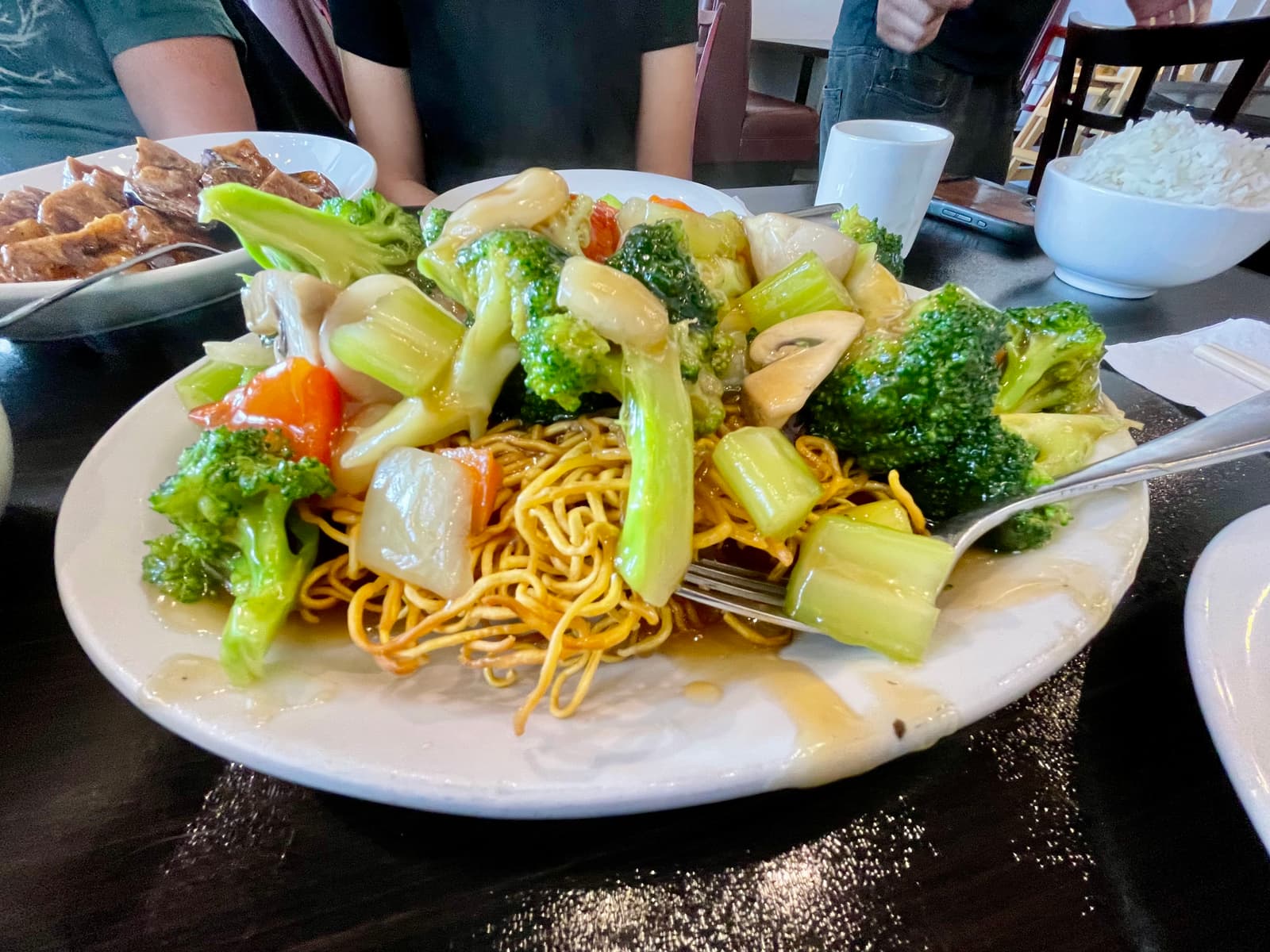
Meanwhile, the vegetable chow mein provides some welcome crunch. I’m always a sucker for noodles with a bit of texture, and these have the sort of satisfying crispness that makes it difficult to stop reaching for another forkful. There’s something wonderfully comforting about a plate of chow mein, particularly when it’s prepared with care and arrives in a portion that suggests the kitchen has no interest in sending anyone home hungry.
The tofu with eggplant in black bean sauce is Adele’s favourite, and it’s easy to understand why. The eggplant practically melts in the mouth, soft and yielding, with the savoury depth of the black bean sauce bringing everything together. Adele declares it good, laughing, before reiterating just how good it is. Sometimes a dish needs no more elaborate description than that. The texture does most of the talking, and the sauce gives you every reason to keep going back for another bite.
Taylor takes on the sesame balls, whose crisp, crunchy exterior gives way to a soft, starchy rice and sweet bean filling. They’re the sort of thing that makes an excellent end to a meal, even when you’ve already eaten enough to reconsider your plans for the afternoon. Of everything on the table, they end up being the crowd favourite.
After lunch, Jason tells me a little more about Jade Yi’s Kitchen. The restaurant has been operating for more than a decade, although it has been at its current Kanata Avenue location for about three years. It previously operated on Teron Road in Beaverbrook, and has built up a clientele that, according to Jason, is roughly evenly split between Chinese and non-Chinese diners. The menu covers both Cantonese and Szechuan cooking, and while weekends are busy, things are a little quieter during the week.
Jason’s own preference leans towards Szechuan food and its heat, which is understandable if you enjoy a little fire with your dinner. But I’ve heard from members of Ottawa’s Chinese community that Jade Yi’s is one of the city’s better Cantonese restaurants, and what we’ve eaten certainly lends credence to that reputation.
The restaurant also draws families for its dim sum. The space is too small to accommodate the traditional carts that circulate through larger dim sum restaurants, so the dishes are ordered from the menu instead. I’m told the owner will be in later that day, and Jason suggests I call her to learn more about her background and the restaurant. I do, but she explains that she isn’t comfortable speaking English, so I leave it there. There’s a point at which asking questions becomes an imposition on people who are busy running a restaurant, and I’m conscious that Jason is already juggling several jobs at once. Sometimes the most respectful thing to do is put the notebook away and let people get on with their work.
And the food, after all, gives me plenty to think about.
One of the things I’ve come to appreciate while writing this blog is just how misleading the term Chinese food can be. In North America, we’ve historically associated Chinese cooking with Cantonese cuisine, in large part because of the patterns of Chinese immigration and the communities that established themselves here. But China is enormous, and its regional cuisines are varied enough that treating them as a single culinary tradition makes about as much sense as assuming that every European country eats the same food.
The more I explore these restaurants, the more I realise how much there is to learn. The ingredients, techniques, flavours and traditions that define one corner of China can be quite different from those found in another. There’s a whole world of food behind the broad labels we tend to use, and a restaurant like Jade Yi’s is a reminder that some of the best ways to understand that world are to sit down, order a few dishes and pay attention.
We didn’t get around to ordering anything from the dim sum selection this time, which feels like a missed opportunity given why I was so keen to visit in the first place. Har gow is firmly on the agenda for my next trip. Still, the dumplings we did order were enough to convince me that there’s plenty here worth returning for.
Jade Yi’s isn’t trying to reinvent anything, and it doesn’t need to. This is no-nonsense cooking, served in generous portions, with an emphasis on flavour and substance rather than presentation. We paid around $70 for three people and ate like champions. There was more than enough food on the table, and nobody left hungry.
For me, the pork, chive and egg dumplings were the highlight, especially with a little soya sauce. Made from scratch and full of flavour, they were the sort of simple, satisfying dish that stays with you long after lunch is over. The sesame balls won the popular vote around the table, while Adele’s affection for the eggplant was hard to dispute.
If you’re in Kanata and craving good Cantonese cooking, Jade Yi’s Kitchen is well worth seeking out. And if dim sum is what you’re after, all the better. I’ll be back for the har gow, but those dumplings have already given me a very good reason to return.
Closed, moved, or changed? Know a spot we should try? Email us